Section outline

  • Introduction / Introducción

    • The main aim of this resource is to exemplify standards of Cambridge IGCSE First Language Spanish, Component 3, and show how different levels of candidates' performance (high, middle and low) relate to the subject's curriculum and assessment objectives. 

      Candidate responses have been selected from the June 2025 examination series to exemplify a range of answers. 

      The recording of each speaking and listening test is followed by Cambridge moderator comments on how the test was conducted, and where and why marks were awarded or omitted. At the end of the test we provide further comments on how the teacher/examiner and candidate performance could improve. In this way, it is possible for you to understand how to conduct the test successfully and what candidates have to do to gain their marks and what they can do to improve their answers. 

      A transcript of the audio recordings with additional commentary is also provided. 

      Please note: Information about the candidate and centre has been removed from the recordings to protect the identity of the candidate.


      El objetivo principal de este recurso es ejemplificar los estándares de Cambridge IGCSE First Language Spanish, Componente 3, y mostrar cómo los diferentes niveles de rendimiento de los candidatos (alto, medio y bajo) se relacionan con el plan de estudios y los objetivos de evaluación de la asignatura. 

      Las respuestas de los candidatos han sido seleccionadas de la serie de exámenes de junio de 2025 para ejemplificar una variedad de respuestas. 

      La grabación de cada prueba de expresión oral y comprensión auditiva va seguida de los comentarios del moderador de Cambridge sobre cómo se llevó a cabo la prueba y dónde y por qué se otorgaron o omitieron las calificaciones. Al final de la prueba, ofrecemos más comentarios sobre cómo podrían mejorar el rendimiento del profesor/examinador y del candidato. De este modo, es posible comprender cómo realizar la prueba con éxito y qué deben hacer los candidatos para obtener sus calificaciones y qué pueden hacer para mejorar sus respuestas. 

      También se proporciona una transcripción de las grabaciones de audio con comentarios adicionales. 

      Nota: Se ha eliminado de las grabaciones la información sobre el candidato y el centro para proteger la identidad del candidato.

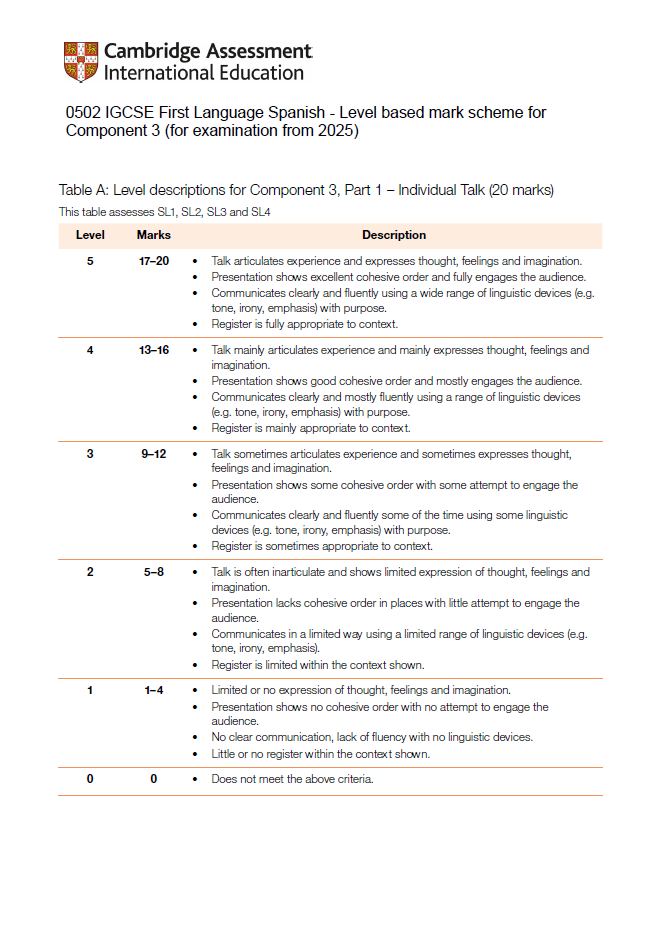
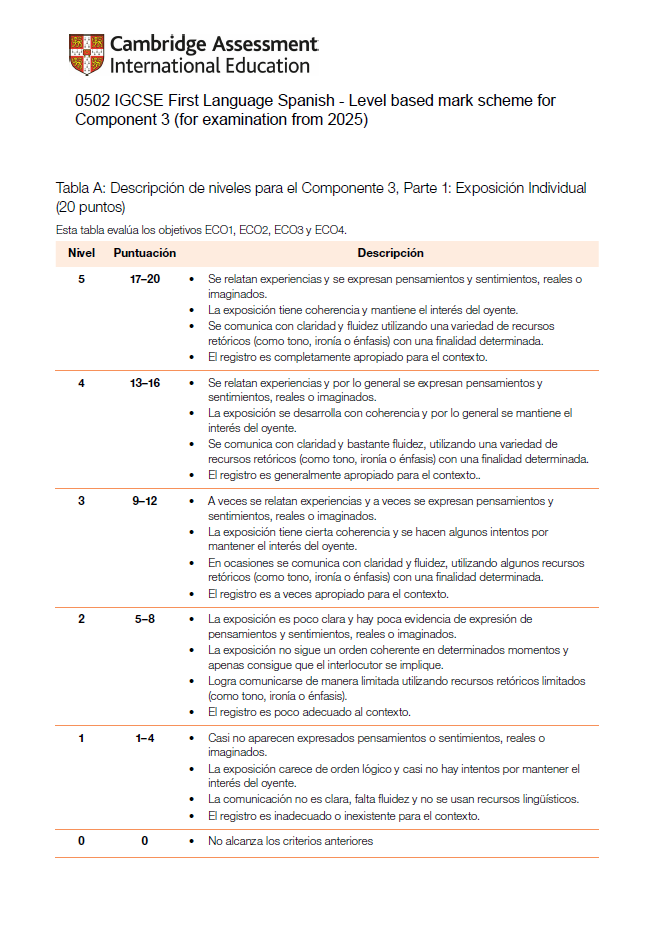
  • Mark schemes / Esquemas de calificaciónes
    Mark scheme (English)

    Mark scheme (Spanish)

    • Now that you have read the mark schemes, you may want to practise marking a speaking and listening test. Listen to the candidate responses below, make a note of the strengths and weaknesses of the candidate and give a mark, before you read the moderator comments and marks below.


      Ahora que ha leído los criterios de calificación, tal vez desee practicar la calificación de una prueba de expresión oral y comprensión auditiva. Escuche las respuestas de los candidatos que figuran a continuación, tome nota de sus puntos fuertes y débiles y asigne una calificación antes de leer los comentarios y las calificaciones del moderador que figuran más abajo.


  • High level response / nivel alto 

      • Whole test - click to listen

    • Moderator comments / Comentarios del moderador/a
      Part 1 Individual Talk / Parte 1 Charla individual

      Conduct of the test / Realización de la prueba

      The teacher/examiner introduces the candidate correctly. There is no need to intervene during the presentation.

      La examinadora presenta a la candidata de forma correcta. No tiene necesidad de intervenir durante la presentación.


      Candidate response / Respuesta del candidato/a

      The presentation connects the listener with Badolato's history and present. Badolato is a small town in Italy. The incorporation of a family experience reinforces the idea of ​​how personal and local stories can be intertwined with global history. A relatable, narrative tone prevails, inviting the listener to imagine the place and connect with the town's history. This style is suitable for a wide audience, especially if the goal is to tell a story or inspire curiosity about Badolato. The use of verb tenses is consistent and well-coordinated, facilitating the transition between historical events and the present. Communication was clear and fluent, always using the appropriate register and maintaining the interest of the listener.

      La presentación logra conectar al oyente con la historia y el presente de Badolato, una ciudad pequeña de Italia. La inclusión de una experiencia familiar refuerza la idea de cómo las historias personales y locales pueden entrelazarse con la historia global. Predomina un tono cercano y narrativo, que invita al oyente a imaginarse el lugar y conectar con la historia del pueblo. Este estilo es adecuado para un público amplio, especialmente si el objetivo es contar una historia o inspirar curiosidad por Badolato. El uso de los tiempos verbales es coherente y bien manejado, facilitando la transición entre eventos históricos y el presente. La comunicación ha sido clara y fluida utilizando siempre el registro apropiado y manteniendo el interés del oyente.

      Mark awarded = 20 out of 20 / Puntos otorgados = 20 / 20


      Part 2 Conversation / Parte 2 Conversación

      Conduct of the test / Realización de la prueba

      Overall, the questions were well designed to encourage personal reflection, connect with emotions, and explore more abstract ideas. At no point was there a need to assist the candidate, as they managed to control the conversation. The timing was appropriate.

      En general, las preguntas están bien diseñadas para fomentar reflexiones personales, conectar con emociones y explorar ideas más abstractas. En ningún momento ha habido necesidad de ayudar al candidato/a ya que esta ha sabido controlar la conversación. El tiempo utilizado ha sido correcto.


      Candidate response / Respuesta del candidato/a

      The answers are clear and well-founded in most cases. The candidate combines personal ideas with general reflections, enriching answers while demonstrating an ability to reflect on complex topics such as migration, technology, and cultural change. Overall, the candidate answers with confidence, which enhances the overall impression.

      Las respuestas son claras y están bien fundamentadas en la mayoría de los casos. El candidato/a mezcla ideas personales con reflexiones generales, enriqueciendo sus respuestas, demostrando, al mismo tiempo, capacidad para reflexionar sobre temas complejos como migración, tecnología, y cambios culturales. En general, el candidato/a responde con confianza, lo que mejora la impresión general.

      Mark awarded for Speaking = 10 out of 10 / Puntos otorgados por hablar = 10/10

      Mark awarded for Listening = 10 out of 10 / Puntos otorgados por escuchar = 10/10

      Total mark awarded = 20 out of 20 / Puntos totales otorgados = 20/20


      Final total mark awarded = 40 out of 40 / Puntos totales otorgados = 40/40


      Whole test / Prueba completa


      How the teacher/examiner performance could improve / Cómo podría mejorar el desempeño del profesor/a / examinador/a

      Although the teacher/examiner's questions are mostly correct, some of them could benefit from greater conciseness and clarity to avoid confusion or redundancies.

      Aunque las preguntas del profesor/a / examinador/a son en su mayoría correctas, algunas de ellas podrían beneficiarse de mayor concisión y claridad para evitar confusiones o redundancias.


      How the candidate performance could improve / Cómo podría mejorar el rendimiento del candidato/a

      In general, oral exams favour students who prepare well and disadvantage those who do not take the exam seriously. In this case, some minor improvements, such as greater variation in vocabulary and structure, could make the exam more dynamic and engaging.

      En general, el examen oral favorece al candidato/a que prepara bien el tema y perjudica al que no se lo toma en serio. En este caso algunas mejoras menores, como mayor variación en el vocabulario y estructura, podrían hacer el examen más dinámico e interesante.

  • Middle level response / nivel medio

      • Whole test - click to listen

    • Moderator comments / Comentarios del moderador/a
      Part 1 Individual Talk / Parte 1 Charla individual

      Conduct of the test / Realización de la prueba

      The teacher/examiner introduces the candidate correctly. There is no need to intervene during the presentation.

      El profesor/a / examinador/a presenta al candidato/a de forma correcta. No tiene necesidad de intervenir durante la presentación.


      Candidate response / Respuesta del candidato/a

      The candidate meets most of the Level 4 criteria: they convey information and make comparisons coherently, generally maintaining the listener’s interest and communicating clearly for most of the speech. The presentation on the differences between Denmark and Mexico is well organised by topics (geography, language, culture, gastronomy, climate, tourism, and personal opinion) and combines specific details with personal observations, making it relatable and clear. The candidate uses some expressive devices and the register is appropriate for an academic presentation, although it does not reach Level 5 because there are repetitions, minor accuracy errors, and a need for greater variety of rhetorical devices and a stronger conclusion. Overall, it is a good piece of work that, with slight adjustments in accuracy, fluency, and synthesis, could gain strength and better maintain the audience’s attention.

      El candidato/a cumple con la mayoría de los criterios del Nivel 4: relata información y comparaciones de forma coherente manteniendo, en general, el interés del oyente y comunicando con claridad en la mayor parte del discurso. La presentación sobre las diferencias entre Dinamarca y México está bien organizada por temas (geografía, idioma, cultura, gastronomía, clima, turismo y opinión personal) y combina datos concretos con observaciones personales, lo que la hace cercana y clara. El candidato/a utiliza algunos recursos expresivos y el registro es adecuado para una exposición académica, aunque no llega al Nivel 5 porque hay repeticiones, pequeños errores de precisión y falta más variedad de recursos retóricos y una conclusión más fuerte. En general, es un buen trabajo que, con ligeros ajustes en precisión, fluidez y síntesis, podría ganar fuerza y mantener mejor la atención del público.

      Mark awarded = 14 out of 20 / Puntos otorgados = 14 / 20


      Part 2 Conversation / Parte 2 Conversación

      Conduct of the test / Realización de la prueba

      In this conversation, the teacher/examiner plays a clear and well-structured role. The teacher/examiner's interventions follow a logical sequence: they revisit points mentioned in the presentation (climate, individualism, language, traditions, food, tourism), ask open-ended questions that invite the development of ideas, and, when necessary, clarify or redirect. This helps the candidate stay focused and provides opportunities to expand the candidate's responses. The teacher/examiner also uses different types of questions and maintains a friendly and neutral tone, which supports the candidate’s fluency.

      En la parte de la conversación, el profesor/a / examinador/a cumple un papel claro y bien estructurado. Sus intervenciones siguen una secuencia lógica: retoma puntos mencionados en la presentación (clima, individualismo, idioma, tradiciones, comida, turismo), formula preguntas abiertas que invitan a desarrollar ideas y, cuando es necesario, aclara o reconduce. Esto ayuda a que el candidato/a mantenga el foco y tenga oportunidades de expandir sus respuestas. El profesor/a / examinador/a también usa diferentes tipos de preguntas y mantiene un tono cordial y neutral, lo que favorece la fluidez del candidato/a.

      Candidate response / Respuesta del candidato/a

      The candidate’s responses in this part show a good willingness to participate and expand on ideas, which helps keep the conversation active. The candidate revisits points already mentioned in the presentation (climate, individualism, gastronomy, Day of the Dead), which gives coherence to the interaction. There is a continuous participation, always answering questions without long pauses or getting stuck. The work fits Level 4 as it meets coherence, overall clarity, and interaction criteria, but it does not reach the higher level due to a lack of expressive variety and argumentative depth.

      Las respuestas del candidato/a en esta parte muestran buena disposición a participar y a ampliar ideas, lo que contribuye a mantener la conversación activa. El candidato/a retoma puntos ya mencionados en la presentación (clima, individualismo, gastronomía, Día de Muertos), lo que da coherencia a la interacción. Hay una participación continua, respondiendo siempre a las preguntas, sin dejar silencios largos ni bloquearse. El trabajo encaja en el nivel 4 ya que cumple con la coherencia, la claridad general y la interacción, pero no alcanza el nivel superior por falta de variedad expresiva y profundidad argumentativa.

      Mark for Speaking: 8 out of 10 / Puntos otorgados por hablar = 8/10

      Mark for Listening: 7 out of 10 / Puntos otorgados por escuchar = 7/10


      Total mark awarded = 29 out of 40 / Puntos totales otorgados = 29/40


      Whole test / Prueba completa


      How the teacher/examiner performance could improve / Cómo podría mejorar el desempeño del profesor/a /examinador/a

      In summary, the teacher/examiner fulfils their main role of guiding the conversation and giving the candidate space to demonstrate skills, although a more systematic use of follow-up questions and clarifications could have helped elicit richer and more precise responses.

      En resumen, el profesor/a / examinador/a cumple su función principal de guiar la conversación y dar espacio al candidato/a para demostrar sus habilidades, aunque un uso más sistemático de repreguntas y aclaraciones podría haber ayudado a obtener respuestas más ricas y precisas.


      How the candidate performance could improve / Cómo podría mejorar el rendimiento del candidato/a

      The candidate’s work could be improved by providing more structured responses and using more varied vocabulary. The quality of the conversation would also have been enhanced if the candidate had gone deeper into cultural or comparative aspects to move beyond the obvious.

      El trabajo del candidato/a podría mejorar usando respuestas más estructuradas y utilizando un vocabulario más variado. La calidad de la conversación también habría mejorado si el candidato/a hubiera profundizado más en los aspectos culturales o comparativos para ir más allá de lo evidente.

  • Low level response / nivel bajo

      • Whole test - click to listen

    • Moderator comments / Comentarios del moderador/a
      Part 1 Individual Talk / Parte 1 Charla individual

      Conduct of the test / Realización de la prueba

      The teacher/examiner introduces the candidate correctly. There is no need to intervene during the presentation.

      El profesor/a / examinador/a presenta al candidato/a de forma correcta. No tiene necesidad de intervenir durante la presentación.


      Candidate response / Respuesta del candidato/a

      The presentation shows a good understanding of the topic and an ability to argue points, with specific examples and appropriate vocabulary.

      The use of rhetorical questions and examples makes the presentation more engaging and dynamic.

      The tone is appropriate and the register is correct. However, some ideas are presented in a somewhat scattered way; for example, the benefits of connectivity are mixed with marketing and education for people with disabilities without a clear transition. Similarly, some examples need further development or explanation; for instance, the phenomenon of ‘ghosting’ could be linked more explicitly to its negative effects.

      The conclusion is too brief and general; it could summarise both the positive and negative aspects more clearly and offer a final recommendation.

      La presentación demuestra buena comprensión del tema y capacidad de argumentación, con ejemplos concretos y vocabulario adecuado.

      El uso de preguntas retóricas y de ejemplos hace la presentación más cercana y dinámica.

      El tono es apropiado y el registro correcto. Sin embargo, algunas ideas se presentan de manera un poco dispersa; por ejemplo, los beneficios de la conectividad se mezclan con el marketing y la educación para personas con discapacidad sin transición clara. De igual manera, algunos ejemplos necesitan mayor desarrollo o explicación; por ejemplo, el fenómeno ‘ghosting’ podría vincularse más explícitamente a sus efectos negativos.

      La conclusión es demasiado breve y general; podría resumir tanto los aspectos positivos como los negativos de forma más clara y ofrecer una recomendación final.

      Total mark awarded = 12 out of 20 / Puntos otorgados = 12 / 20


      Part 2 Conversation / Parte 2 Conversación

      Conduct of the test / Realización de la prueba

      In general, the questions are well designed, encouraging personal reflections, emotional connection, and the exploration of more abstract ideas.

      On some occasions, the teacher/examiner had to provide support to the candidate, but effectively used open-ended questions to allow the candidate to develop different aspects of the conversation.

      The time used was appropriate.

      En general, las preguntas están bien diseñadas, fomentando reflexiones personales, la conexión con emociones y la exploración de ideas más abstractas.

      En algunas ocasiones, el profesor/a / examinador/a ha tenido que brindar ayuda al candidato/a, pero ha utilizado eficazmente preguntas abiertas para permitirle desarrollar distintos aspectos de la conversación.

      El tiempo empleado ha sido adecuado.


      Candidate response / Respuesta del candidato/a

      The responses are sometimes too general or repetitive, for example, when the candidate talks about social anxiety or the role of parents. The candidate tends to oversimplify solutions (‘dejando aparte las redes sociales’ - “leaving aside social media”) without explaining more practical strategies or nuances.

      Some concepts could have been developed further: for example, the positive impact of social media could include specific examples of learning or collaborative work.

      Some ideas are presented in a somewhat disorganised way, mixing causes, effects, and solutions without clear transitions.

      On some occasions, the candidate does not expand enough or limits themself to brief statements (‘No’) at the end, missing the opportunity to conclude with a stronger reflection.

      Las respuestas son a veces demasiado generales o repetitivas, por ejemplo, cuando habla de ansiedad social o del rol de los padres. El candidato/a tiende a simplificar soluciones (‘dejando aparte las redes sociales’) sin explicar más estrategias prácticas o matices.

      Algunos conceptos podrían haberse desarrollado más: por ejemplo, el impacto positivo de las redes sociales podría incluir ejemplos concretos de aprendizaje o trabajo colaborativo.

      Hay ideas que se presentan de forma un poco desordenada, mezclando causas, efectos y soluciones sin transiciones claras.

      En algunas ocasiones, el candidato/a no expande lo suficiente o se limita a afirmaciones breves (‘No’) al final, perdiendo la oportunidad de cerrar con una reflexión más fuerte.

      Mark awarded for Speaking: 4 out of 10 / Puntos otorgados por hablar = 4/10

      Mark awarded for Listening: 5 out of 10 / Puntos otorgados por escuchar = 5/10


      Final total mark awarded = 21 out of 40 / Puntos totales otorgados = 21/40


      Whole test / Prueba completa


      How the teacher/examiner performance could improve / Cómo podría mejorar el desempeño del profesor/a / examinador/a

      The teacher/examiner’s role in this conversation is quite good: they asks open, and follow-up questions and allows the candidate to express themself freely. However, the conversation jumps from one topic to another (anxiety, truth on social media, cybersecurity, the role of parents) without clear transitions.

      The teacher/examiner could structure the questions into blocks: negative effects, possible solutions (schools, psychologists), the role of parents and security, positive impacts, and recommendations. This would help the candidate organise their ideas better and avoid repetitions.

      At the end, the teacher/examiner could ask for a reflective closing. Instead of ‘¿quieres decir algo más?’- “Is there anything else you would like to add?” the teacher/examiner could encourage the candidate with a phrase like: ‘Si tuvieras que dar un consejo a tus compañeros sobre el uso de redes sociales, ¿qué dirías?’- “What advice would you give your fellow classmates about the use of social media?”

      El papel del profesor/a / examinador/a en esta conversación es bastante bueno: hace preguntas abiertas, de seguimiento y permite que lel candidato/a se exprese con libertad. Sin embargo, la conversación salta de un tema a otro (ansiedad, verdad en redes sociales, ciberseguridad, rol de los padres) sin transiciones claras.

      El profesor/a / examinador/a podría estructurar las preguntas por bloques. Efectos negativos, posibles soluciones (colegios, psicólogos), rol de padres y seguridad, impactos positivos y recomendaciones. Esto ayuda al candidato/a a organizar mejor sus ideas y evita repeticiones.

      Al final, el profesor/a / examinador/a podría pedir un cierre reflexivo. En vez de ‘¿quieres decir algo más?’ se podría estimular al candidato/a con una frase parecida a esta: ‘Si tuvieras que dar un consejo a tus compañeros sobre el uso de redes sociales, ¿qué dirías?’


      How the candidate performance could improve / Cómo podría mejorar el rendimiento del candidato/a

      The candidate needs to improve organisation, transitions between ideas, grammatical accuracy, and a stronger closing in order to reach a higher level.

      The candidate already demonstrates understanding of the topic and the ability to engage in dialogue, but by improving depth, examples, organisation, and lexical range, could significantly enhance their performance in a conversation.

      El candidato/a necesita mejorar la organización, las transiciones entre ideas, la corrección gramatical y un cierre más sólido para alcanzar un nivel más alto.

      El candidato/a ya demuestra comprensión del tema y capacidad para dialogar, pero mejorando profundidad, ejemplos, organización y riqueza léxica, podría elevar significativamente su desempeño en una conversación.
  • Common mistakes and guidance for candidates / Errores comunes, conceptos erróneos y orientación para los candidatos
    • In this type of oral test, candidates often make mistakes such as giving underdeveloped answers, presenting disorganised ideas, providing inaccurate information, and using limited vocabulary. To improve, it is crucial to structure each response, vary the vocabulary, and pay attention to pace and pronunciation. Avoiding filler words and using clear connectors helps achieve greater fluency and coherence.


      On the other hand, teachers/examiners sometimes ask ambiguous questions, fail to follow up, change topics too quickly, or do not adjust the level to the candidate. A good performance involves asking open-ended questions, listening actively and closing each subject area in an orderly way. Thus, it allows the candidate to show their full potential, and the interaction becomes more natural and productive.

      En este tipo de pruebas orales, los candidatos suelen cometer errores como dar respuestas poco desarrolladas, desorganizar sus ideas, aportar datos imprecisos y usar vocabulario limitado. Para mejorar, es clave estructurar cada respuesta, variar el léxico y cuidar el ritmo y la pronunciación. Evitar muletillas y usar conectores claros ayuda a ganar fluidez y coherencia.

      Por su parte, los profesores / examinadores a veces formulan preguntas ambiguas, no profundizan con repreguntas, cambian de tema demasiado rápido o no adaptan el nivel al candidato. Un buen desempeño implica hacer preguntas abiertas, escuchar activamente y cerrar cada bloque temático con orden. Así, el candidato puede mostrar todo su potencial y la interacción resulta más natural y productiva.


      For further details about how candidates performed in this particular examination series please refer to the Principal Examiner Report for Teachers.

      Para obtener más información sobre el rendimiento de los candidatos en esta serie de exámenes en particular, consulte el Informe del examinador principal para profesores.