Section outline
-
-
Example 1
-
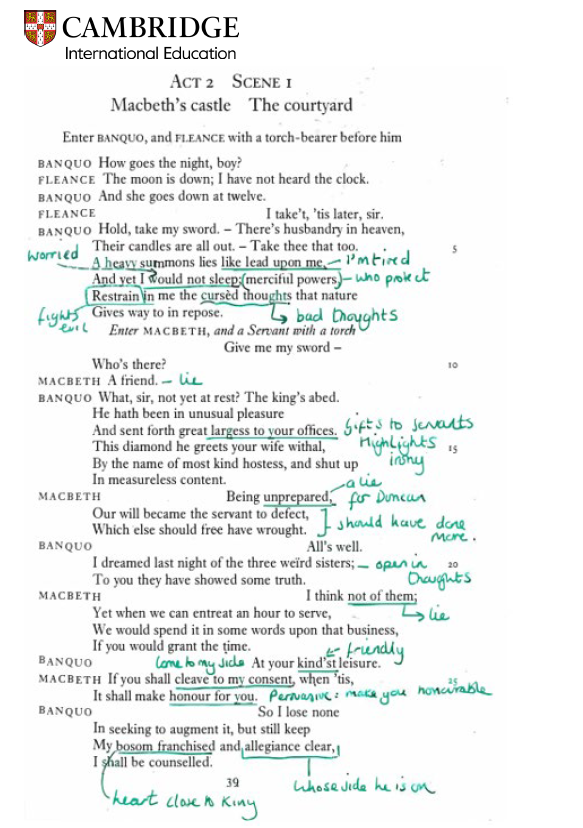
The student has highlighted key words and phrases by:
· underlining - e.g. ‘like lead upon me’, ‘cleave to my consent’
· using brackets – e.g. around the phrase ‘merciful powers’
· circling words – e.g. the word ‘Restrain’.
The notes on the highlighted words and phrases offer brief explanations and comments about characters, for example:
· the straightforward explanation ‘I’m tired’ linked to Banquo’s words ‘like lead upon me’
· the one-word comment ‘lie’ on Macbeth’s statement ‘I think not of them’
This is an example of acceptable annotation for an open text examination.
-
Click to see handwritten notes
-
-
Example 2
-
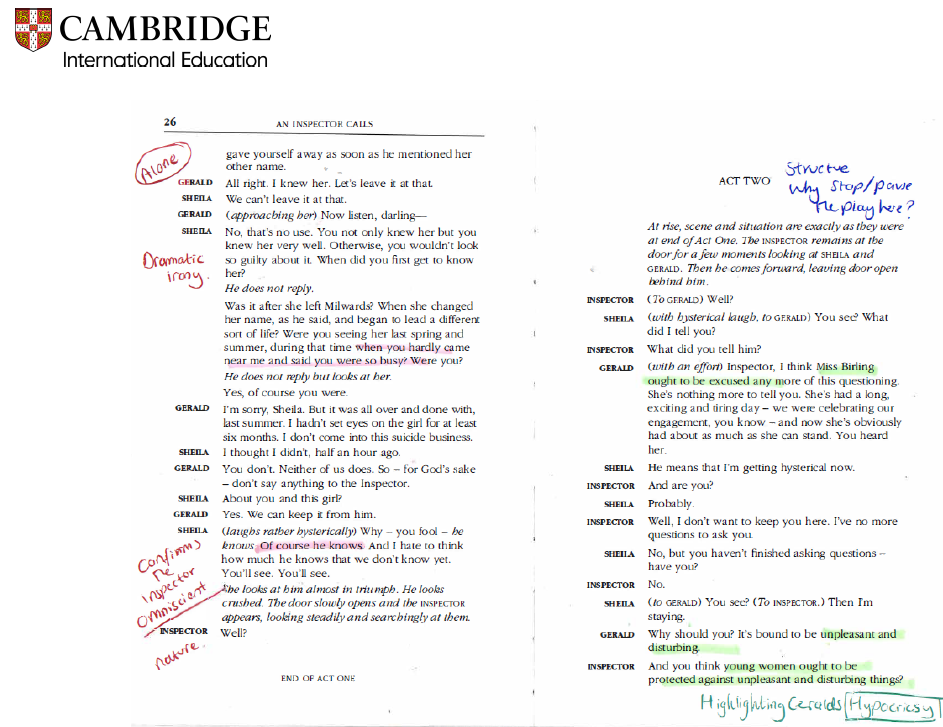
In this example, the student highlights key dialogue and adds brief comments: e.g.
· the comment ‘confirms the Inspector[‘s] omniscient nature’ next to Sheila’s line ‘Of course he knows’
· the comment ‘Highlighting Gerald’s hypocrisy’ next to words spoken by Gerald and the Inspector
The annotation in this example goes beyond explanation by noting aspects of the writer’s techniques: e.g.
· the reference to dramatic irony
· the student’s own question relating to the play’s structure – ‘Why stop / pause the play here?’
These brief notes serve as prompts that would help the student if they need to refer to this part of the play in the exam.
This is an example of acceptable annotation.
-
Click to see handwritten notes
-
-
Example 3
-
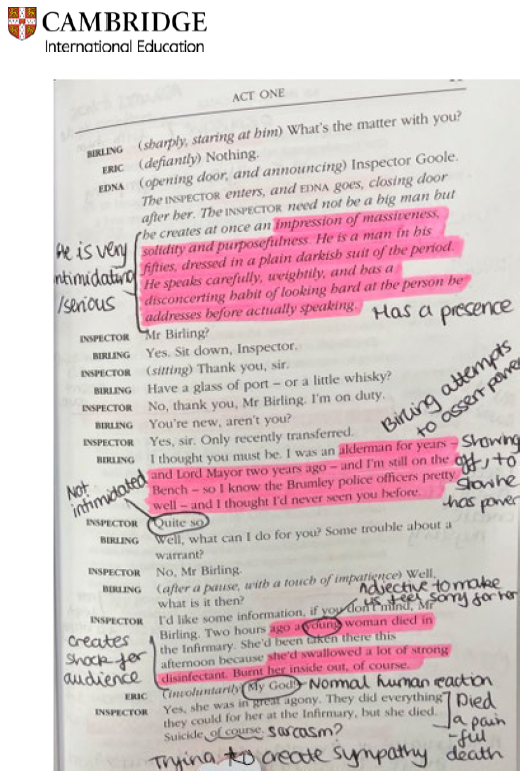
The notes in the margin make useful comments on character; for example, the Inspector ‘is very intimidating’, ‘Has a presence’ and is himself ‘Not intimidated’. There are also useful reminders about the writer creating ‘shock’ and ‘sympathy’, showing that the student is thinking about characters in a play performed in front of an audience rather than real-life people.
This provides acceptable annotation. However, the student could make their annotation more effective for the exam by restricting their use of the highlighter pen. Most of the stage direction that introduces the Inspector is highlighted. A better strategy would be to highlight two phrases that really illustrate the Inspector’s intimidating nature.
-
Click to see handwritten notes
-
-
Example 4
-
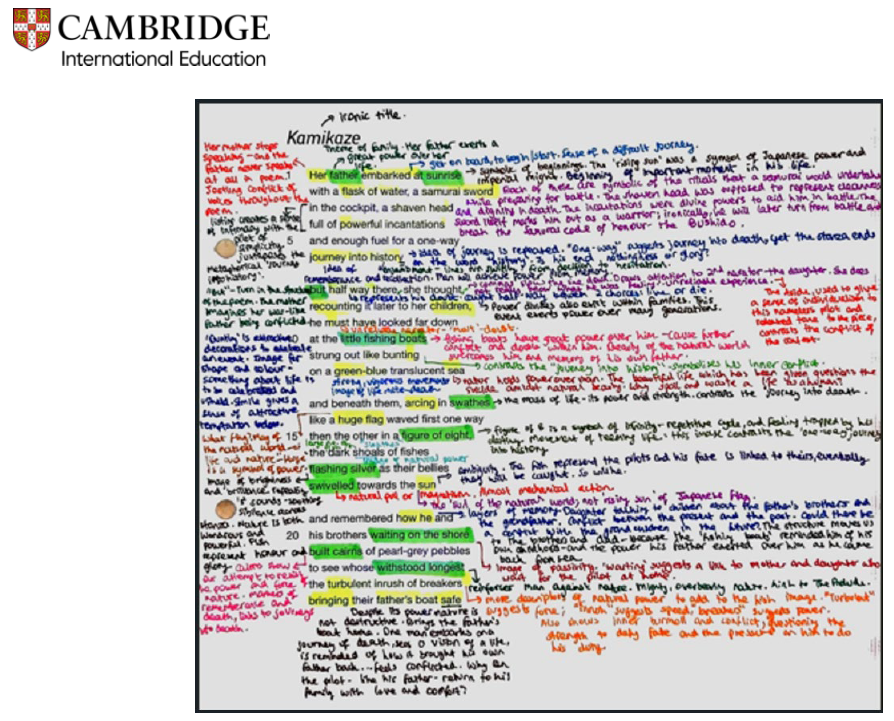
The student has highlighted key words and phrases in the poem, which would provide useful potential quotations in the exam. However, the notes linked to the highlighted text are not allowed, as many are written in sentences, some of them quite extended. Overall, the annotation in this example is not acceptable.
Such detailed notes may help to increase the student’s appreciation of the poem in their revision, i.e. before the exam. However, concise comments in note form would be more helpful in the exam. These would serve as prompts for specific ideas the student might have when responding to the specific question set in the exam. It is important to remember that a poetry question will not simply ask students to unload everything they know about a poem. They must select ideas that address the question.
-
Click to see handwritten notes
-
-
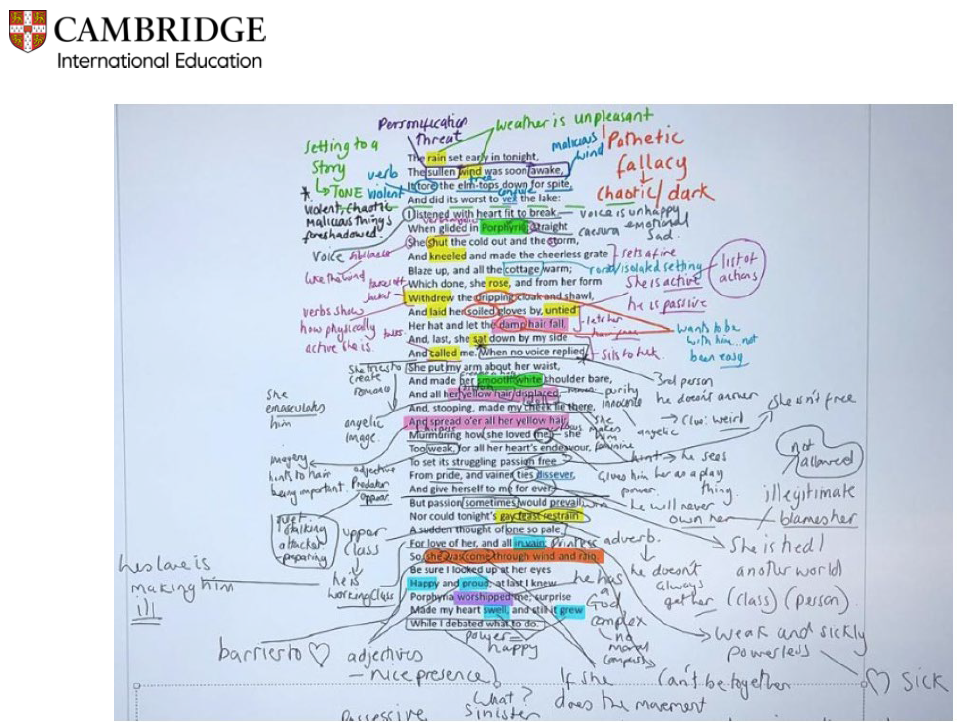
Example 5
-
In this example, the student has used much highlighting, not just by using coloured highlighter pens, but also by underling, circling words and phrases and putting others in boxes.
Although the page appears somewhat busy, the student’s notes are in note form and not in sentences. The notes relate both to ideas in the poem (e.g. the speaker ‘blames her’ and ‘he will never own her’) and the poet’s techniques (e.g. personification, pathetic fallacy, caesura). These will serve as useful prompts in the exam.
Perhaps an even more effective approach would be to write notes about content to the left of the poem and notes on techniques to the right of the poem.
This is an example of acceptable annotation. The student will need to select only those notes that are relevant to the question asked in the exam and should avoid trying to include everything in their notes.
-
Click to see handwritten notes
-
-